



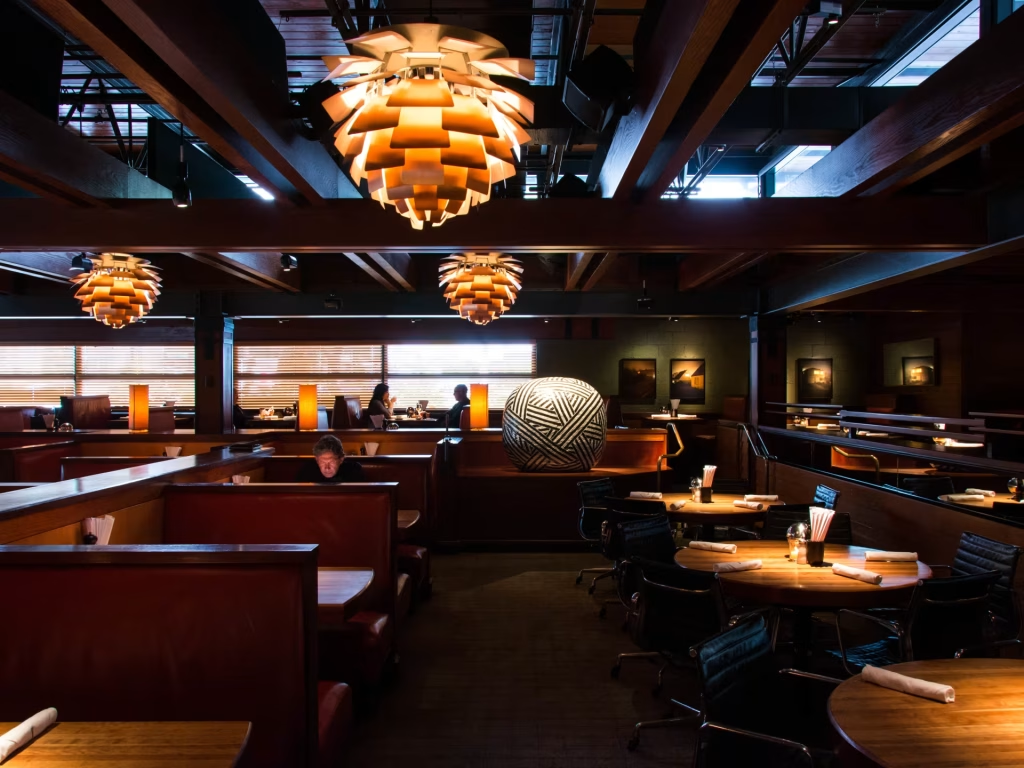
Hillstone restaurants are not Michelin star restaurants. And yet every time I walk into one I think: ahhh, some good lighting, finally. A spotlight on every table, a few decorative fixtures, the art lit. That’s the whole scheme. Simple. And somehow the most dramatic thing in the room is you, your food, your glass, your date.
We design very expensive restaurants for a living. Well above the price point of a Hillstone restaurant, I’m aware of the irony…
The drama in a well-lit restaurant comes from what the light lands on. At Hillstone, it lands on the right things.
The verbs nobody is designing for
Charles Woodbury, a painter would tell his students in the early 1900s to “paint in verbs, not nouns.” He meant: paint what the wave does. Capture its force, its movement, the life of it. The visible thing is just the starting point.
Lighting works the exact same way. Stick with me here. This is where lighting designers usually get themselves lost.
Ask yourself what actually happens in a restaurant. People eat. They drink. They talk. They try to impress each other. They celebrate things. They have hard conversations. They go on first dates and last dates and everything in between. Someone is trying to read a menu without their glasses.
Those are the verbs. When we design restaurant lighting at Mood, that’s what we light.
Every decision we make is in service of what people are actually doing inside the room. The glassware needs to sparkle. Your date needs to be lit at an angle that makes them look like the best version of themselves. (That is a significant part of what a great restaurant is actually selling, if we’re being honest.) The food needs directional light and contrast or it goes flat.
Look always for the -ing words, we’re eating, drinking, and talking. To put it simply.
Most restaurant lighting today does a good job of serving the architectural concept. The photograph. The idea of atmosphere, packaged and presented rather than actually felt. You end up with rooms that look incredible in a wide shot and feel vaguely wrong when you’re sitting in them, and you can’t quite put your finger on why.
They lit the nouns, not the verbs.
When you strip the contrast out of a room in pursuit of even, ambient warmth, the sparkle on the glassware disappears. The steak looks grey. The faces around the table lose their definition. The whole point of the room is forgotten, and it happens so gradually that nobody can name it.
This has been solved before

Lighting Design by Richard Kelly
Richard Kelly lit the Four Seasons Pool Room in 1959. (He also invented the idea of a lighting consultant as a profession. He worked with Mies, Kahn, Saarinen. If you’re in this industry and you don’t know his name, stop and fix that.)
For the tables, he used framing projectors aimed precisely at the table surface. No spill beyond the edge of the tablecloth. The only light leaving the table was what reflected back up from the linen. Each table appeared to float in the dark floor of the room.
That’s directional spotlighting taken to its most precise, considered conclusion. And it was done in 1959.
The industry had the answer and spent the next sixty years walking away from it.
How spotlighting fell out of fashion
To be frank, not everyone was working with the precision, or budget of the Four Seasons restaurant. And there were plenty of Lighting Designers not really understanding how to balance the full room.
That is all to say, It was done badly for a long time.
Harsh pools of light on tables with dead zones between them. Wrong color temperatures making food look grey and faces look worse. A coldness that felt clinical. So the industry overcorrected toward even, ambient warmth and decided that was sophistication.
An aside about color temperature
Allow me to put a soapbox on a soapbox here for a second.
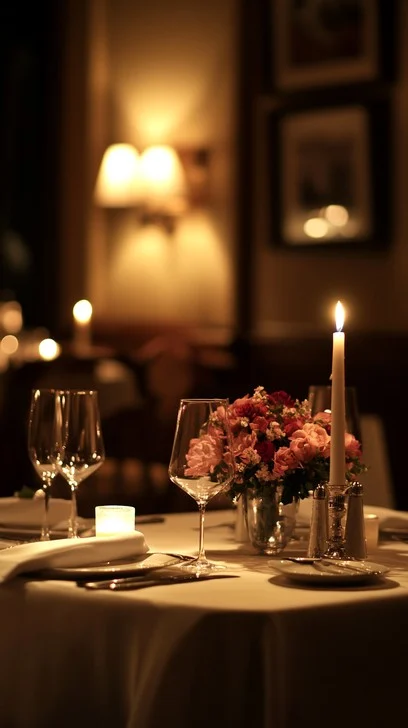
The overall industry, landed on 2700k as warm white and largely stopped asking questions. Candlelight sits around 1800k. There is an enormous amount of warmth left unused between those two numbers, and restaurants are where that gap matters most.
The whole point is that people feel good, feel relaxed, feel like the evening is going well. We have evolved as a species to like fire, it’s safety, it’s literal warmth in the coldness of the world. These warm colors excite something within us, it’s very much pre-civilization, certainly pre-Hillstone.
Ok, back to the spotlights. All I hope you know is that when we talk spotlights, we’re taking about something warm, probably warmer than you’re thinking.
I promise.
How to balance the space
Spotlighting every table is a precise tool. The difference between doing it badly and doing it well comes down to a few things. Color temperature pushed into genuinely warm territory. (Like literal candlelight) The ambient layered carefully so the transition between lit tables and the rest of the room feels considered. Decorative fixtures that give the room personality. The art lit, because our eyes are on the front of our head, so vertical surfaces are more important to us than horizontal. (I really am about this “lighting for humans” thing if you can’t tell)
When it’s right, you don’t notice any of it. You just feel like the table you’re at is the most important place in the room.
Some technical recommendations
There’s really no getting around it, you’re going to need a single light per table. Maybe 2 if it’s long, but you really want to do as much as you can with a single source so that you don’t cast a billion distracting shadows when your hand reaches for your glass of wine.
About the fixture. You want a narrow beam, somewhere between 10 and 25 degrees depending on your ceiling height and table size. An adjustable accent as we like to call it. The goal is a tight pool of light that stops at the edge of the table. You don’t want this too large… You want to make sure that when someone leans in for a conversation, they’re not assaulted by this intense light.
You want this coming straight down, or as directly straight down as you can get it. When we try and light tables off-axis, the shadows of the plates are elongated, and the servers will likely cast even larger shadows as they approach the table too.
That being said, that’s pretty much it. Put the light over the table.
Mood is everything
The goal is a room where people eat well, drink freely, talk easily, and don’t want to leave. Where the food looks like it’s supposed to be, the evening feels like it’s going well, and something about the whole experience stays with you even after you’ve forgotten what you ordered.
That’s the mood, and the lighting is just one part of it.
Hillstone figured that out. They aimed the lights at the right things and let the room do the rest.
We spend a lot of time and money trying to get to the same place. Sometimes the most considered thing you can do is keep it that simple.